 AGM Deep Cycle batteries are designed for specific applications.
It is important to ensure that you have adequate capacity in the battery for the amount of power your application will consume (known as Amp Hours). The following battery calculation guide is a great place to start.
By establishing the power consumption of each piece of equipment or item (usually marked in Max Watts or Max Amps on the information label of each item) – then taking into account the number of hours you will utilise battery power between recharges, and the Voltage of the system – you can then calculate the Amp Hours that you require.
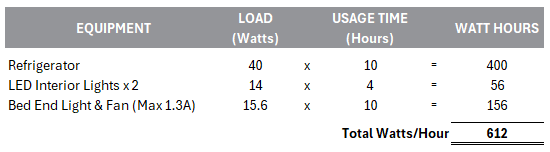
Now that you have calculated the total watt hours for your requirements…divide the total Watt-Hours by the Supply Voltage to obtain the Amp Hours.
612 Watt Hours ÷ 12 Volts = 51 Amp Hours
As a rule of Thumb, and because DC electrical systems are not always perfect, one more very important calculation that we suggest.
We strongly recommend that you allow a little extra power in reserve. Add a safety margin of say 30% to your calculation just be safe.
51 + 30% Safety Margin (15.3) = 66.3 Total Amp Hours
IMPORTANT NOTE – AGM deep cycle batteries should not be discharged below 50% of their total capacity to prevent permanent damage and extend their life.
Now that you have calculated your load and run time requirements, you can purchase the correct AGM Deep Cycle battery to suit your needs.
P.S – To convert Amps to Watts simply multiply the item Amps x Voltage (i.e. “Bed End Light & Fan” 1.3 Amps x 12 Volts = 15.6 Watts, as shown within the example table above).
Watts = Amps x Volts
Click the following link for “Battery Discharge Status” data table.
Battery Discharge Status
Important Considerations
The calculated time is an estimate; actual run time can vary due to several factors:
- Depth of Discharge (DoD): Discharging an AGM battery to a lower DoD (e.g., 80% or 100%) will provide longer individual run times but will significantly shorten the overall lifespan and number of charge cycles the battery can handle.
- Discharge Rate: A battery’s Ah rating is often based on a 20-hour discharge rate (C20). Drawing a very high current (e.g., 100A from a 100Ah battery for 1 hour) may yield less than the theoretical capacity due to internal resistance and chemical inefficiencies.
- Temperature: Both high and low temperatures affect battery performance. High heat accelerates degradation, while cold temperatures reduce available capacity.
- Battery Age and Condition: An older battery will have a reduced capacity compared to a new one.